Rungraph — Development skill for Claude Code
One command turns every agent session already on your disk into a graph: subagents, tool calls, retries, the moments you said no. Ask your agent what happened and the graph lights up the nodes it mean.
How to install Rungraph
This entry records only its repository, not the path inside it, so there is no
exact command to give. Open fayzan123/rungraph and copy the folder into
~/.claude/skills/, or the file into ~/.claude/agents/.
What Rungraph does
One command turns every agent session already on your disk into a graph: subagents, tool calls, retries, the moments you said no. Ask your agent what happened and the graph lights up the nodes it means. npx rungraph: no hooks, no setup, all local. Works with Claude Code, Codex, Hermes, opencode and Cursor.
Alternatives in Development
- n8n Code Python — Python coding in n8n Code nodes with limitations 3.6k ★
- Comfy Search Nodes — Search for ComfyUI nodes available on Comfy Cloud: $ARGUMENTS 178 ★
- Bm Stats — Show the basemind dashboard — resource footprint (disk + RAM) and activity (tool calls, per-tool histogram, es 94 ★
README
rungraph
**Ask your agent what happened. Watch the graph answer.** [fayzan123.github.io/rungraph](https://fayzan123.github.io/rungraph/) embeds a real run you can click around.
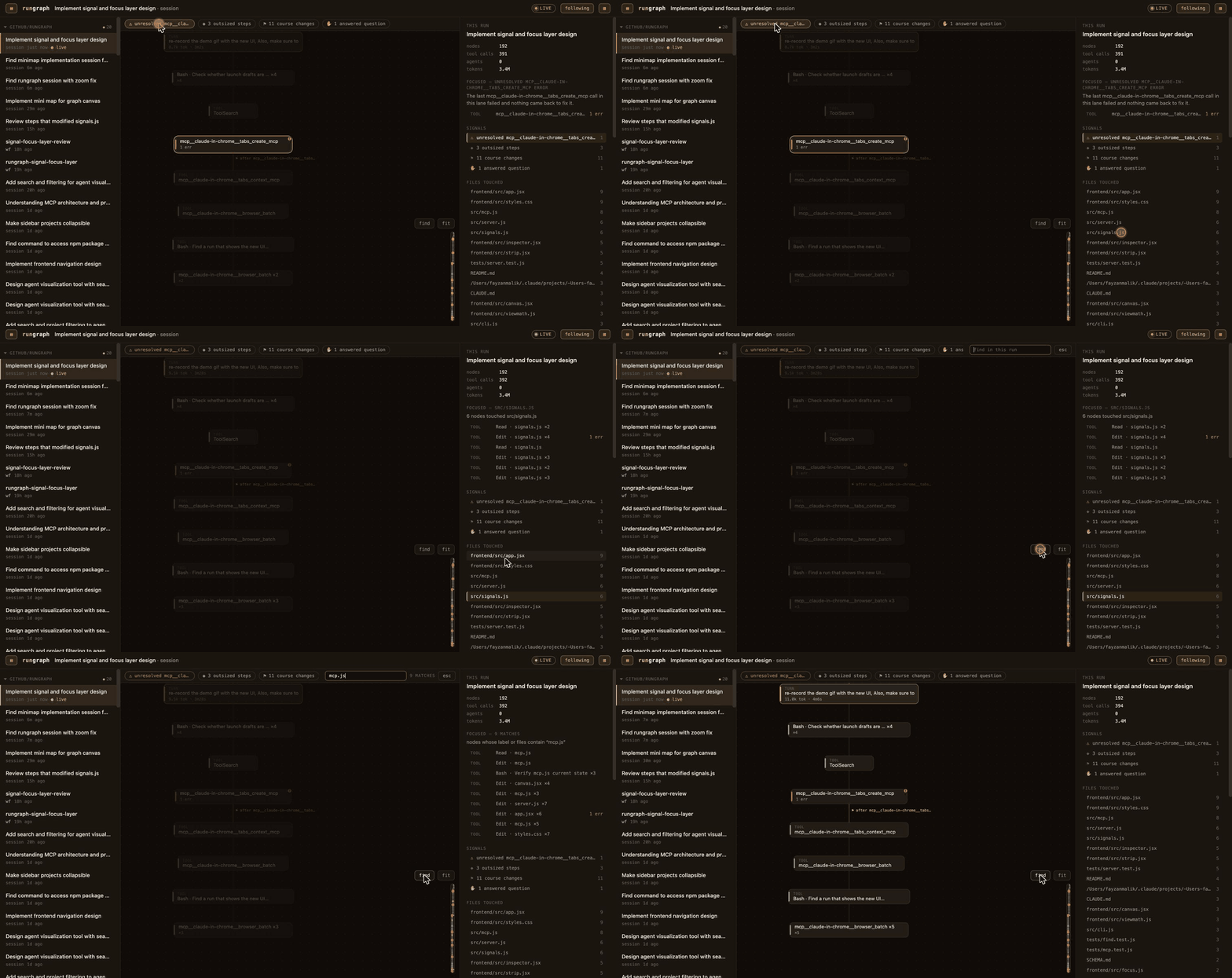
Your agent already wrote down everything it did. `rungraph` turns those transcripts into an interactive graph — orchestrator, subagents and tools as nodes, spawn/return edges, the moments a human said no marked on the path — and hands your agent the same graph over MCP. Ask *"why did the Edit on `token.js` keep failing?"* in your terminal: the answer arrives there, from your own model, and the graph you have open **lights up the exact nodes the answer is about**.
npx rungraphThat's the whole quickstart. It finds every Claude Code, Codex, Hermes Agent, opencode and Cursor run still on your disk, starts a local server and opens your browser. No hooks, no wrappers, no telemetry — it works retroactively, and a run that's happening right now grows live as the agent works.
Hermes, opencode and Cursor runs need Node ≥ 22.13 for the built-in SQLite reader. On older Nodes they're skipped with a warning; everything else works.
**New here?** [docs/GUIDE.md](docs/GUIDE.md) walks through reading the graph, what each signal means, wiring it to your agent, and what to do when something looks broken.
What you see
- Time flows down. Your prompts are the backbone; parallel agents fan out into lanes and return to the turn that collected their result.
- Tool nodes say what ran:
Bash · npm test ×12,Edit · canvas.jsx. Consecutive calls of the same tool collapse into one node, so a test-fix loop isn't a hairball. - Click any node for the full story — prompt and response for turns; every call's inputs
Related Skills
Capture Postmortem
Reconstruct a strict, structured timing/diagnostic report from a /capture run THIS SAME conversation already d

Reapply
Handle an application to somewhere that already said no


Se Agent Control Wanted Full
agent control / wanted: sets ask.wanted to full. What the owner wants said at the end of this turn.

Se Agent Control Wanted Quiet
agent control / wanted: sets ask.wanted to quiet. What the owner wants said at the end of this turn.
Quantified Claude
Counts which Claude Code skills you actually reach for, plus the agents, models, and tokens behind them—read f

Cogload
Keep your head cold. A thermometer for your Claude Code days: every hour scored 0 to 100 from the transcripts

Related Agents
Meeting Qualifier
Use when someone shows interest, asks about price or how it works, or asks for a call. Decides book, ask or pa

Kb Extraction Worker
Turn ONE raw or vendored source file into one graphify {nodes, edges, hyperedges} extraction chunk and write i


Agent Tool Integration Engineer
Use this agent to wire tools and function-calling into an agent loop reliably — clean tool schemas, errors fed
