
Sit — Testing skill for Claude Code
⚙️ [Skill] A Git-native semantic safety layer for AI agents editing Skill packages — validates, diffs, reviews, and gates prompt/schema/test changes before they ship.
How to install Sit
This entry records only its repository, not the path inside it, so there is no
exact command to give. Open OpenRaiser/Sit and copy the folder into
~/.claude/skills/, or the file into ~/.claude/agents/.
What Sit does
⚙️ [Skill] A Git-native semantic safety layer for AI agents editing Skill packages — validates, diffs, reviews, and gates prompt/schema/test changes before they ship.
Alternatives in Testing
- Debug — You are tasked with helping debug issues during manual testing or implementation 10k ★
- Playwright Automation — git clone Browser automation skill for end-to-end testing and web interaction 2.3k ★
- Spec Kitty — Spec-Driven Development for serious software developers 1.6k ★
README
Quick Start | Why sit? | Real Case | Agent Loop | PyPI | Releases
Real case: see how paper-webpage-builder uses Skill-style prompts, schemas, scripts, and golden behavior checks.
**A Git-native safety layer for AI agents that edit prompts, schemas, scripts, and Skill packages.**
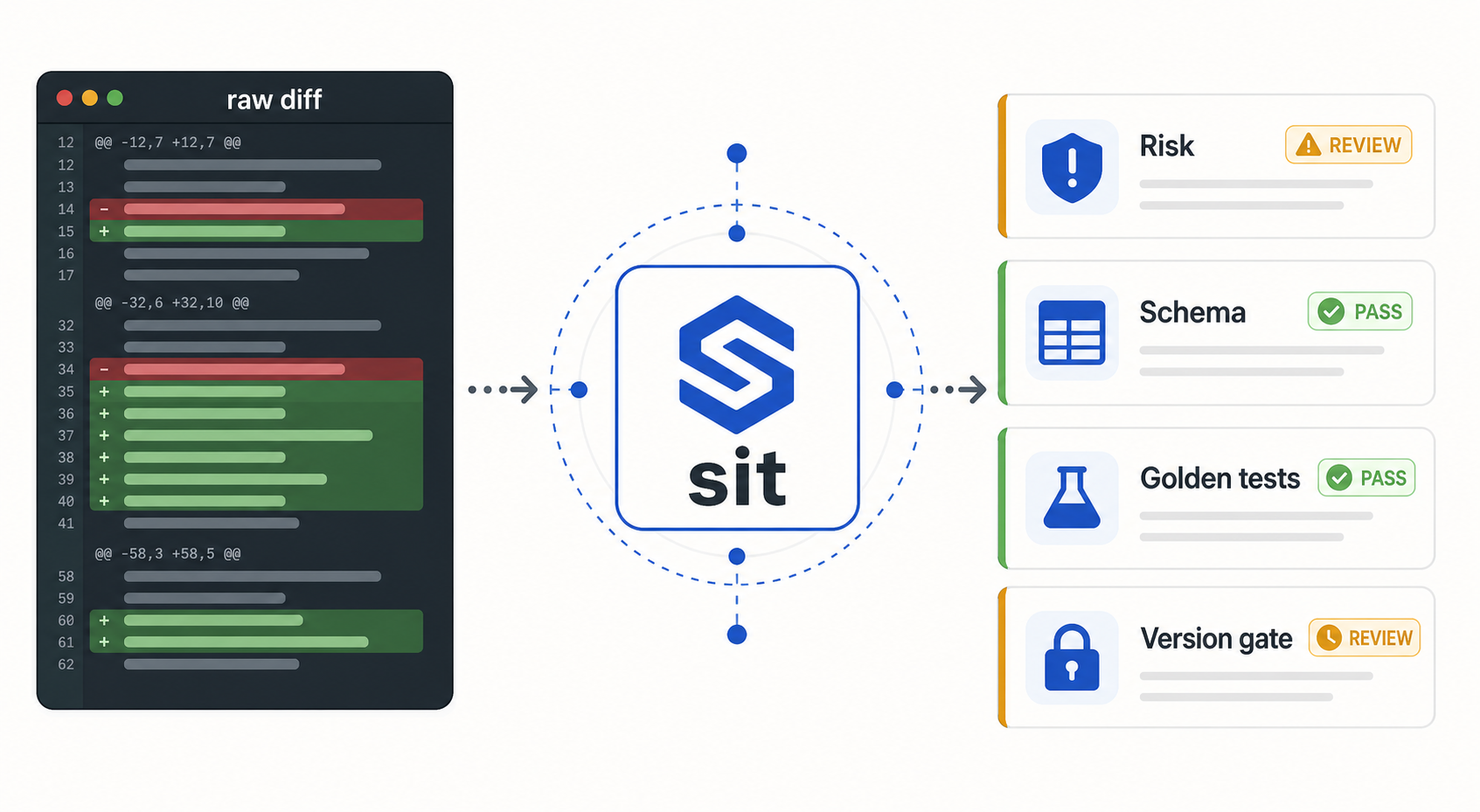
Git can tell you that a prompt changed. `sit` tells you whether that change is a typo fix, a behavior change, a schema contract change, a test update, or a release risk.
pip install sit-toolkit
sit diff HEAD..WORKTREE
sit review HEAD..WORKTREE
Use `sit` when humans or AI agents evolve reusable skills and you need semantic diffs, golden tests, version gates, PR reviews, and reproducible releases without replacing Git.
Why sit?
AI Skill packages are not just
Related Skills
Orchestrate Skill
Ledger-based orchestration skill for Claude Code — plan, fence, review, and smoke-test multi-batch changes wit


Claude Codepro
by Max Ritter - Professional development environment for Claude Code with spec-driven workflow, TDD enforcemen


Scipy Spec Rules
Standards from Scientific Python SPECs 0, 4, and 6. Apply when managing dependency versions, deprecation timel

Ke Spec
Create or refine a requirements-first engineering specification without editing application code.


Mda
MDA Open Spec — a Markdown superset for agent-facing documents. One .mda source compiles to drop-in SKILL.md,

Contract Version Bump
Classify and apply a version bump to a machine-readable contract (JSON Schema, API spec, config schema) — vers

Related Agents

Diff Reviewer
Use when changes touch internal/diff/, internal/parser/, internal/merge/, or match key / field comparison logi


Render QA
Renders a built artboard, records deterministic visual/GIF evidence, and applies render, contrast, seam, motio


🎨 Customization & Editing Guide
🌟 Created by SenaiVerse Claude Code Agent System for Expo/React Native Development --- Learn how to modify ag
