
Agent Dispatch — AI skill for Claude Code
Free skill for Claude Code, Cursor and any agent client: picks the model for each subagent by the type of task — small for translations and mechanical work, big for design, code and the final review.
How to install Agent Dispatch
This entry records only its repository, not the path inside it, so there is no
exact command to give. Open Octonove/agent-dispatch and copy the folder into
~/.claude/skills/, or the file into ~/.claude/agents/.
What Agent Dispatch does
Free skill for Claude Code, Cursor and any agent client: picks the model for each subagent by the type of task — small for translations and mechanical work, big for design, code and the final review. Declares the split, reports the measured spend.
Alternatives in AI
- Claude Task Master — by eyaltoledano - A task management system for AI-driven development with Claude, designed to work seamlessly 26k ★
- Codeburn — Free, local tool to track AI coding token usage and cost across 37 tools and agents (Claude Code, Cursor, Code 9.7k ★
- Agentrq — AgentRQ: Human-in-loop realtime conversational task manager for AI Agents 1.1k ★
README
Agent Dispatch — which model runs each subagent
[](LICENSE) [](SKILL.md) [](README.es.md)
A free, standalone skill that stops every subagent from running on your biggest model.
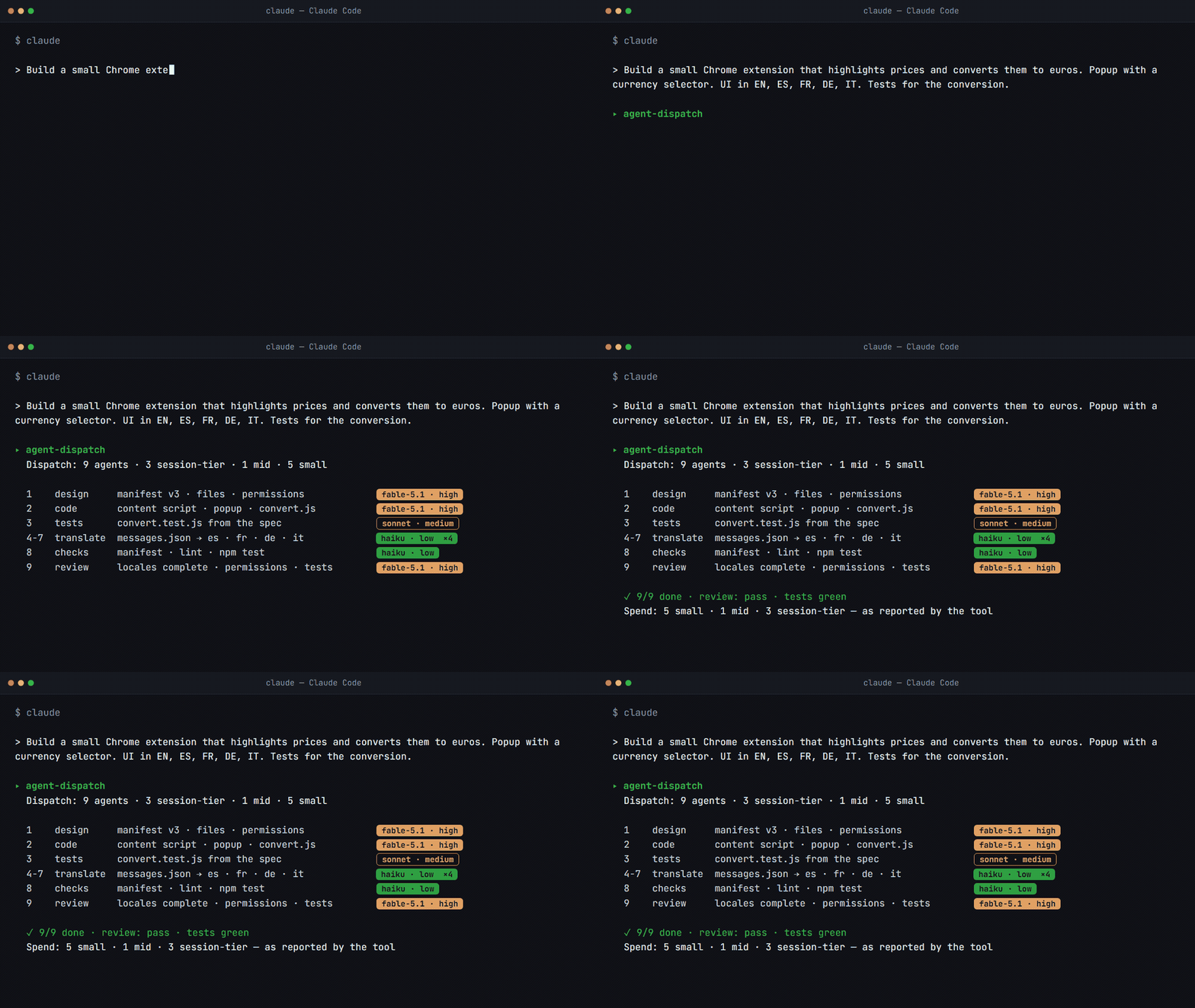
By default, Claude Code hands every subagent the model you have selected for the session. So when a task fans out into nine agents, all nine run on Fable 5.1 (or Opus, or whatever you picked) — the four that translate a `messages.json` file cost the same per token as the one that designs the architecture. This skill makes the split explicit before anything launches: **the model is picked by the type of task, never by the importance of the project.**
The rule in one table
| Type of task | Examples | Model · effort |
|---|---|---|
| Mechanical | translations of fixed strings, listing, counting, measuring, running a script and reporting the output, checking that a manifest parses | small (e.g. Haiku) · low |
| Bounded analysis | summarizing a module, mapping dependencies, writing tests from a clear spec, one mechanical change across many files | mid (e.g. Sonnet) · medium |
| Judgment | architecture, writing the code that decides how something works, choosing between options, the final review, anything that ships | the session's model (e.g. Fable 5.1, Opus) · high |
Plus four guardrails the skill enforces: the final reviewer never gets cheapened; a small agent that fails moves the task up a tier instead of being retried; fewer agents beat more agents; and every run **declares its split before launching and reports the measured spend after** — or says "not measured". No invented savings.
Worked example: a
Related Skills
Divorce Practice
AI co-counsel for divorce and family-law attorneys — a jurisdiction-portable scaffold across the full matter l

OpenCode Most
Use any OpenCode Zen model (Muse Spark, Big Pickle, Ling, MiMo, Nemotron...) from Claude Code or any OpenAI cl

Kg RAG Development Design Harness
Addon layer for Claude Code that turns app and website work into checkable artifacts: plans whose claims are v

Daymods
Small, independent mods for Claude Code: install only the ones you want. Starting with autoroute, which picks

Okfy
Knowledge engineering for AI agents: distill corpora too big for any context window into small, verified, git-

Supervisor Skill Claude
Multi-agent quality gate skill for Claude Code that researches, reviews, tests and challenges AI-generated wor

Related Agents

Implementer Simple
Implements one SMALL, bounded task test-first - a mechanical change, a rename, a config tweak, a fix touching

Us Performance Grader
US stock performance grader. Grades past picks on the v6.3 RANK bar (BIG WIN = weekly rank ≤ 100, WIN = ≤ 500,

Grunt
Handles mechanical, judgment-free chores with a single obviously-correct outcome — running commands, gathering
