

LLM Task Orchestrator — AI skill for Claude Code
Top AI Router 2026: Split Codex for Quick Code & Claude for Complex Refactoring.
How to install LLM Task Orchestrator
This entry records only its repository, not the path inside it, so there is no
exact command to give. Open naberbabammm34343/llm-task-orchestrator and copy the folder into
~/.claude/skills/, or the file into ~/.claude/agents/.
What LLM Task Orchestrator does
Top AI Router 2026: Split Codex for Quick Code & Claude for Complex Refactoring.
Alternatives in AI
- Agent Rules Books — AGENTS.md rules / skills for AI coding agents: Codex, Cursor & Claude Code 2.6k ★
- LongHorizon Harness — The long-horizon computer-use harness 1.3k ★
- Maestro Companion — Quick execution for small tasks — minimal run lifecycle (start + done) with evidence recording 530 ★
README
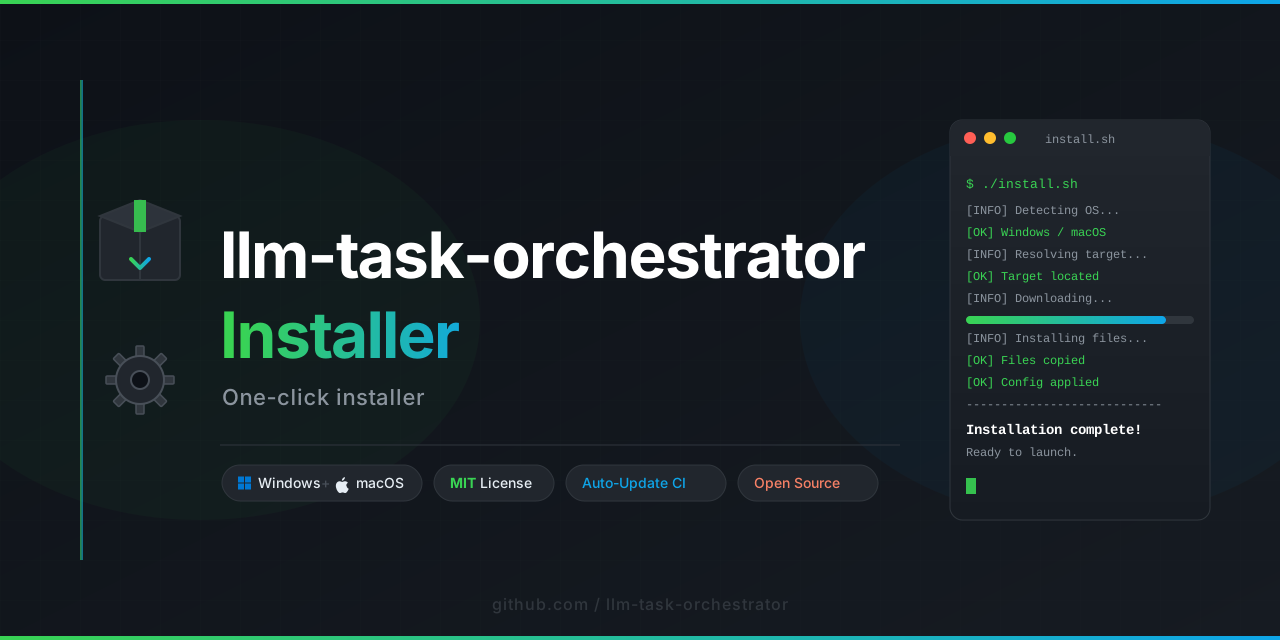
Polyphonic Decision Engine
**Polyphonic Decision Engine** is an orchestration layer for large language model routing that transcends simple load balancing. Where typical routers treat LLMs as interchangeable parts, Polyphonic treats each model as a distinct instrument in an ensemble—selecting the right voice for each task based on deep semantic analysis of the request's structure, ambiguity level, novelty, and required reasoning depth.
Built for teams managing complex AI workflows, this system deterministically routes high-volume, pattern-matching tasks to faster models while reserving deeper analytical capacity for ambiguous architectural decisions, refactoring challenges, and creative problem-solving. Every routing decision is fully auditable, with complete provenance tracking from request intake through response delivery.
Overview
Modern software development increasingly depends on multiple AI models, each with unique strengths and weaknesses. The challenge is not merely choosing a model, but orchestrating them with intentionality—ensuring that the right cognitive load reaches the right processing engine.
Polyphonic Decision Engine approaches this challenge through what we call **semantic routing triage**: each incoming request is analyzed across multiple dimensions including structural complexity, domain specificity, novelty coefficient, and ambiguity index. Based on this analysis, the engine directs the request to the optimal model while maintaining a complete, deterministic audit trail of every decision.
The system operates on a fundamental insight: **not all code tasks are created equal**, and treating them as such wastes both resources and cognitive potential. By matching task characteristics to model capabilities, teams achieve higher quality outputs, faster turnaround times, and more predictable resource consumption.
**Key differentiator:** U
Related Skills

Vmr
A local-first, single-binary LLM router & Agent flight recorder. Automatically turns byte-faithful logs into s


Xu Maestro
XuMaestro is a powerful and flexible workflow orchestrator for AI agents (Gemini & Claude). it allows you to d

Agent Team Orchestrator
Multi-Agent Collaboration Orchestration System based on LangGraph - Automatically decomposes complex tasks and

Task Split
You are a Task Decomposition AI assistant. Your primary function is to break down a user's request or goal int


Agent Task Breakdown
Decompose a complex task into clear subtasks an AI agent (or agents) can execute and verify step by step.

Karpathy Guidelines
Behavioral guidelines to reduce common LLM coding mistakes. Use when writing, reviewing, or refactoring code t

Related Agents
Brain Router
Use PROACTIVELY for ambiguous or compound code-quality requests. Top-level orchestrator. Delegate here when th


Timps AI Safety Agent
Audit LLM applications against OWASP LLM Top 10 (LLM01-LLM10) with mitigations. Use the timps_ai_safety_agent

Heavy Task
Executes complex tasks (architecture, multi-file implementation, refactors, deep debugging) delegated by the m
