
Claude Ops Inspector — AI skill for Claude Code
Subagent Verification for Claude AI Code Networks 2026.
How to install Claude Ops Inspector
This entry records only its repository, not the path inside it, so there is no
exact command to give. Open minetechnic2012-lang/claude-ops-inspector and copy the folder into
~/.claude/skills/, or the file into ~/.claude/agents/.
What Claude Ops Inspector does
Subagent Verification for Claude AI Code Networks 2026.
Alternatives in AI
- Pilotfish — Multi-model orchestration layer for Claude Code — the frontier model plans, cheaper models execute, verificati 688 ★
- Ultimate MCP Server — Comprehensive MCP server exposing dozens of capabilities to AI agents: multi-provider LLM delegation, browser 146 ★
- Hypernovum — Agent Ops for your second brain - a 3D IDE for Obsidian built on Three.js 90 ★
README
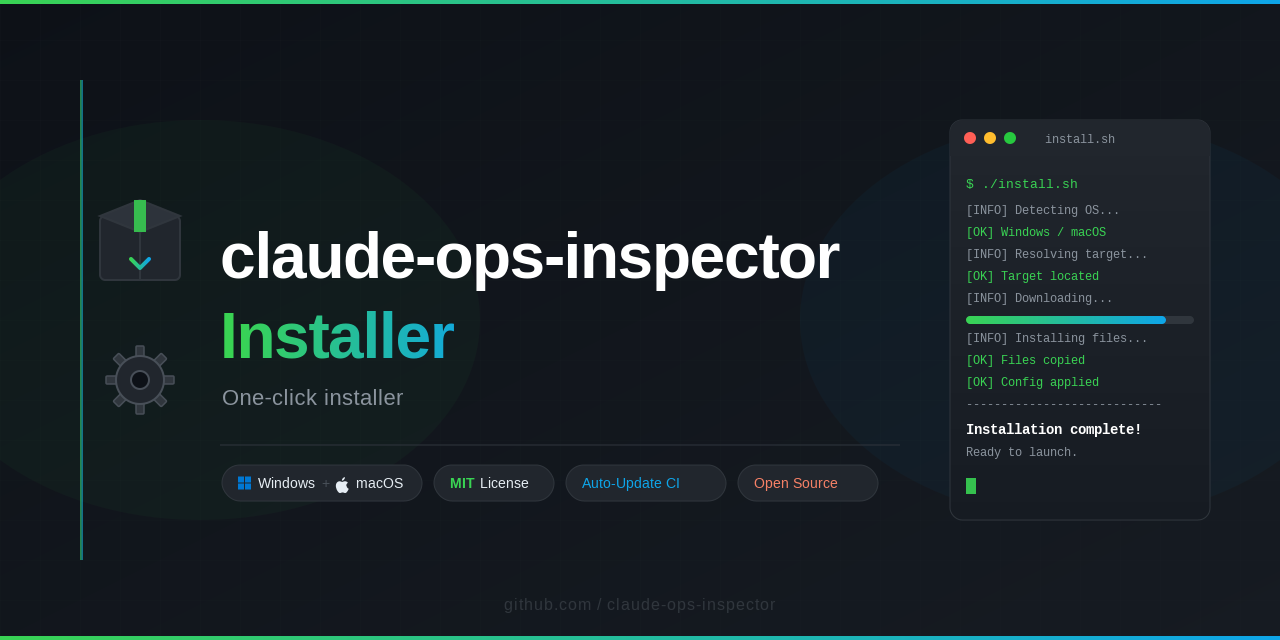
CodeGuardian Swarm – Autonomous Compliance Orchestrators
**A distributed intelligence network of six single-purpose Claude Code subagents that verify, validate, and certify changes across codebases, network configurations, and endpoint management—engineered to Anthropic’s subagent best practices, with a built-in meta-validator that proves the agent files themselves conform to specification.**
Overview
Imagine a team of six tireless specialists—each with a laser-focused mission, a shared language, and an unbreakable commitment to correctness. Welcome to **CodeGuardian Swarm**, a repository that reimagines how teams verify technical changes. Instead of chasing bugs through spreadsheets, email chains, or monolithic CI pipelines that test everything at once, you deploy a **coordinated intelligence** that mimics the best parts of a rigorous code review committee—but runs autonomously, 24 hours a day, across three critical domains: code integrity, network fidelity, and endpoint management.
Each subagent in this swarm is a "guardian" with a single, narrow responsibility. One checks for regressions in pull requests. Another validates that firewall rules match declared intent. A third ensures Intune device compliance policies haven’t drifted. They don’t overlap; they _orchestrate_. When a change enters the system, the relevant guardians awaken, run their verification protocols, and report back—together, in a unified format.
The sixth agent is special: the **Validator**. It doesn’t verify code or infrastructure. It verifies the _agents themselves_—ensuring every file in this repository adheres to the architectural patterns, naming conventions, and behavioral contracts defined by Anthropic’s subagent best practices. If a guardian begins to deviate, the Validator raises an alarm. This is **self-healing metadata**.
Why Not Just Use a Linter?
A linter
Related Skills

Dynamic Architectures
Dynamic/morphogenetic neural networks - grow, prune, adapt topology during training. Continual learning, gradi

Td MCP
Local MCP bridge between AI agents and TouchDesigner: build real networks, set parameters and expressions, val


AI Usage Inspector
Records every AI coding-agent prompt — tokens, model, context %, and cost — from Claude Code, Codex, Cursor, O

Sanityops Inspect Lite
Inspect-only, zero-install inspector for AI Agent logic artifacts (System Prompt, Skill, Tool Schema) - report

Android Layout Inspector MCP
Spatial inspection of a live Android UI for AI agents — finds overlapping views, clipping, touch targets under

Rent Ops
AI 租房助手 — Claude Code Skill,主动扫描各平台房源、智能评估打分、高德地图可视化

Related Agents

Session Replay
Visual session inspector — opens a session, views screenshots at key timestamps, diffs before/after states, an

Ww Judge 06 Freshness Inspector
Wonder Woman 06 freshness inspector. Use only when the Wonder Woman coordinator dispatches this specialist ver


Green CI
CI verification agent. Confirms all CI checks pass on the current HEAD SHA before ops merges — no stale green,
