
Cca Audit — Security skill for Claude Code
Parallel multi-agent code audit + fix pipeline for Claude Code.
How to install Cca Audit
This entry records only its repository, not the path inside it, so there is no
exact command to give. Open GiulioDER/cca-audit and copy the folder into
~/.claude/skills/, or the file into ~/.claude/agents/.
What Cca Audit does
Parallel multi-agent code audit + fix pipeline for Claude Code. One tiered /audit-fix command auto-selects FAST/STANDARD/DEEP by diff size + risk, running up to 11 specialized auditors plus anti-hallucination, anti-regression, and fix→finding verification gates. Any language, one command.
Alternatives in Security
- Anthropic Cybersecurity Skills — 734+ structured cybersecurity skills for AI agents · MITRE ATT&CK mapped · agentskills.io open standard · Work 3.8k ★
- Trail Of Bits Claude-code-config — Opinionated production defaults from a top security firm: sandboxing, permissions, hooks, skills, MCP server c 1.6k ★
- Design Compliance — Audit or generate regulation-specific UI patterns for HIPAA, PCI DSS, or ADA compliance 309 ★
README




CCA-Audit
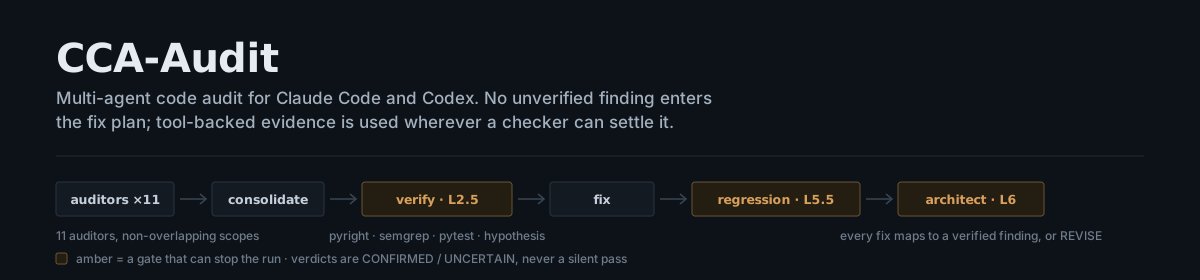
**A multi-agent code auditor for [Claude Code](https://docs.anthropic.com/en/docs/claude-code) and Codex in which no unverified finding is allowed into the fix plan.**
Eleven specialised auditors read your diff in parallel. Their findings are deduplicated, then each one is **re-derived against the real code** — mechanically, by `pyright`, `clippy`, `semgrep`, `pytest` or `hypothesis` wherever a tool can settle the claim, and by adversarial review where none can. Only verified findings that survive that gate are eligible to be fixed. The fix is then checked for scope creep, and the whole change is gated on a mapping proving every confirmed finding has a fix and every edit has a finding.
**Python and Rust** have deterministic settlers. Each language gets the claim vocabulary that actually carries information in it — Rust does not get `nullability`, because the code compiled; it gets `panic_path`, `overflow` and `error_swallow` instead. Any other language, and any claim type a backend does not declare, escalates rather than being settled by a tool built for something else.
The design constra
Related Skills
Sleep
Standard end-of-session consolidation — FAST. Reflection, state banner, journal, archive, commit. The full aud

Simple Onboard
Fast read-only orientation on ANY repo (stack, structure, run/test commands) PLUS a R.Code-suitability verdict

Diff Audit
PR / commit-scoped differential audit — audits only changed functions (plus 1-hop callers), flags removed secu


Security 0day
Scan the current branch's diff (vs main) for 0-day-style vulnerabilities. Light, fast, PR-focused.


Zorille
Four Claude Code skills for codebase hygiene: codebase-audit (find issues) + plan-fixes (turn issues into PR-s


Cleanup Repo
Read-only repo audit for stale/orphaned files, tracked cruft, accidentally-committed secrets, empty files, and

Related Agents

Anti Pattern Selector
Selects a varied subset of anti-patterns for the current kern run. Reads the manifest plus site-specific signa

Feature Crew Triage
Triages a feature-crew request into size/surface/risk/kind and emits crew_plan.json. Invoked after request.md


Nelson
Coordinates multi-agent work using Royal Navy squadron patterns with sailing orders, risk-tiered quality gates
