

Training AI Agents — AI skill for Claude Code
Training architecture for self-improving AI agents.
How to install Training AI Agents
This entry records only its repository, not the path inside it, so there is no
exact command to give. Open FareedKhan-dev/training-ai-agents and copy the folder into
~/.claude/skills/, or the file into ~/.claude/agents/.
What Training AI Agents does
Training architecture for self-improving AI agents.
Alternatives in AI
- Architecture Diagram Generator — Generate beautiful dark-themed system architecture diagrams as standalone HTML/SVG files 7k ★
- Post Training — ai-research-skills GRPO, RLHF, DPO, SimPO 5.4k ★
- Skill Architecture — System architecture and API design with multi-AI consensus — use for design reviews and new subsystems 2.8k ★
README
Training Architecture for Self-Improving AI Agents
Agentic systems, whether designed for tool use or for reasoning, are fundamentally built on prompts. Yet prompts themselves follow a linear, sequential pattern and cannot self-optimize. Real agentic training comes from the way an agent learns, adapts, and collaborates in dynamic environments.
In an agentic architecture each sub-agent has a different purpose, and that means a **single algorithm won’t work for all**. To make them more effective, we need a **complete training architecture** that connects reasoning, reward, and real-time feedback. A typical training architecture for an agentic system involves several interconnected components …
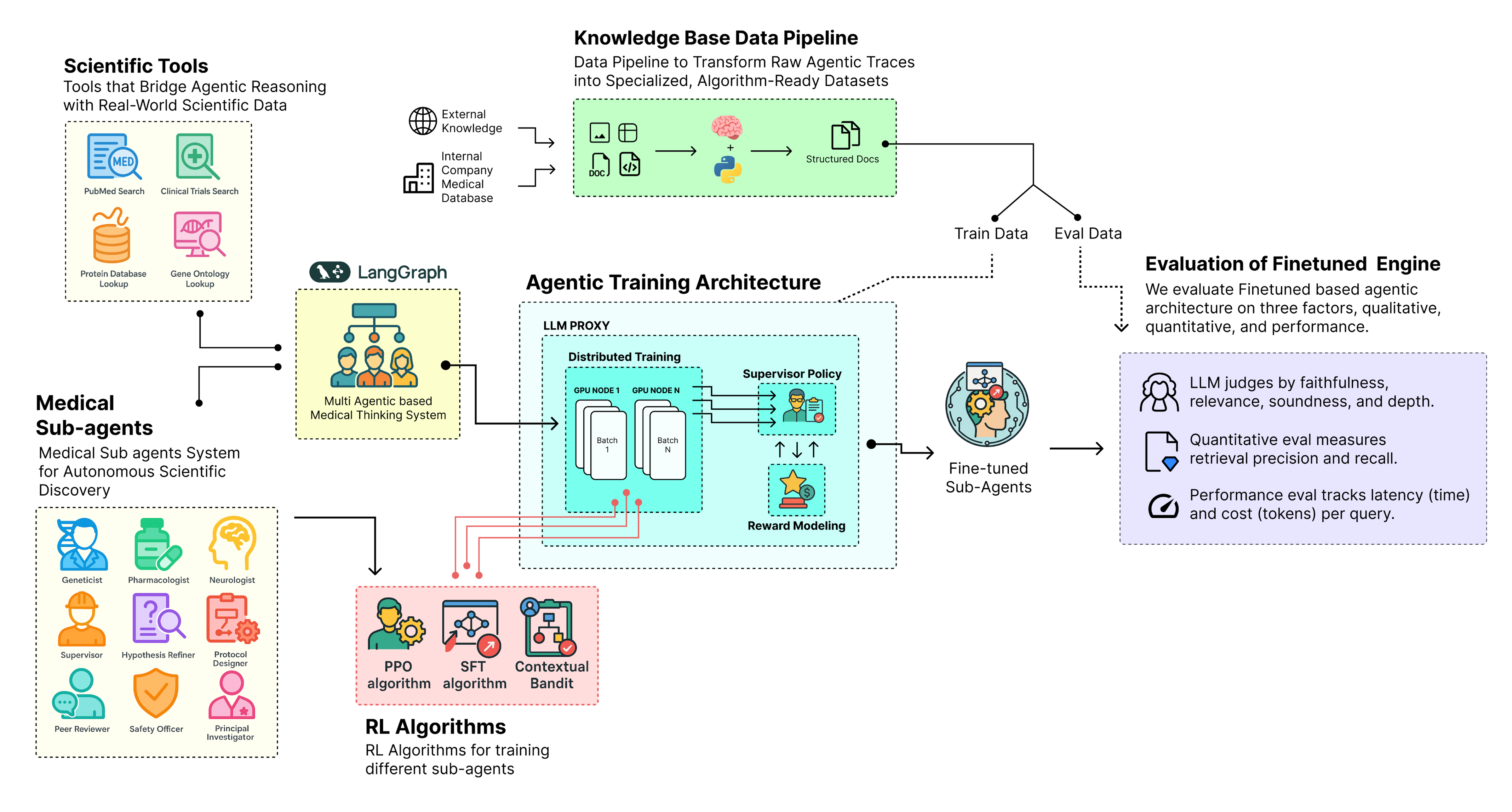
- First, we define the training foundation by setting up the environment, initializing agent states, and aligning their objectives with the system goals.
- Next, we build the distributed training pipeline where multiple agents can interact, learn in parallel, and exchange knowledge through shared memory or logs.
- We add the reinforcement learning layer that powers self-improvement using algorithms like SFT for beginners, PPO for advanced optimization, and contextual bandits for adaptive decision making.
- We connect observability and monitoring tools such as tracing hooks and logging adapters to capture every interaction and learning step in real time.
- We design a dynamic reward system that allows agents to receive feedback based on their performance, alignment, and contribution to the overall task.
- We create a multi phase training loop where agents progress through different stages, from supervised fine tuning to full reinforcement based adaptation.
- Finally, we evaluate and refine the architecture by analyzing reward curves, performance metrics, and qualitative behavior across all agent roles.
I
Related Skills

AI Engineering
Use when starting any AI/ML task and unsure which Yzmir specialist pack applies - routes to PyTorch, training,

Guaardvark
The self-hosted AI studio: local video, image, music, voice, LoRA training, coding swarms, RAG and screen agen


It Manager Claude Training
A 24-week, self-paced interactive learning plan that teaches IT Support Managers how to use Claude effectively

Autovoiceevals
A self-improving loop for voice AI agents. Uses karpathy's autoresearch as foundation.

Claude Improve
A self-improving retrospective skill for Claude Code. One command makes your AI agents get better after every


Real Agent Setup
Turn Antigravity, OpenCode, Claude Code or any AI coding assistant into a fully contextualized, secure, self-i

Related Agents
Agent Improver
Use this agent to analyze agent performance, identify patterns in agent outputs, and generate improvement reco

Auditor Agent
Self-improving auditor. Reads persona evaluation traces and proposes bounded, evidence-driven optimizations to


Frontend Engineer Arnold
Use this agent when you need expert frontend engineering analysis, refactoring, or optimization of React/TypeS
