

Tuipo — Development skill for Claude Code
Grammarly for your terminal — underlines typos in Claude Code, Codex, Aider & any other terminal app.
How to install Tuipo
This entry records only its repository, not the path inside it, so there is no
exact command to give. Open ARahim3/tuipo and copy the folder into
~/.claude/skills/, or the file into ~/.claude/agents/.
What Tuipo does
Grammarly for your terminal — underlines typos in Claude Code, Codex, Aider & any other terminal app.
Alternatives in Development
- OpenAI Codex CLI — (Rust implementation) 67.8k ★
- Hapi — App for Claude Code / Codex / Gemini / OpenCode, vibe coding anytime, anywhere 3.6k ★
- Codenotch — A macOS app that pins usage limits from Claude Code, Cursor, Codex, and Antigravity to a screen edge 1.3k ★
README
tuipo
**Grammarly for your terminal.**
The red squiggly line from your editor — now for the prompts you type into Claude Code, Codex, Aider, and any other terminal app.
[](#license) [](#install) [](https://crates.io/crates/tuipo)
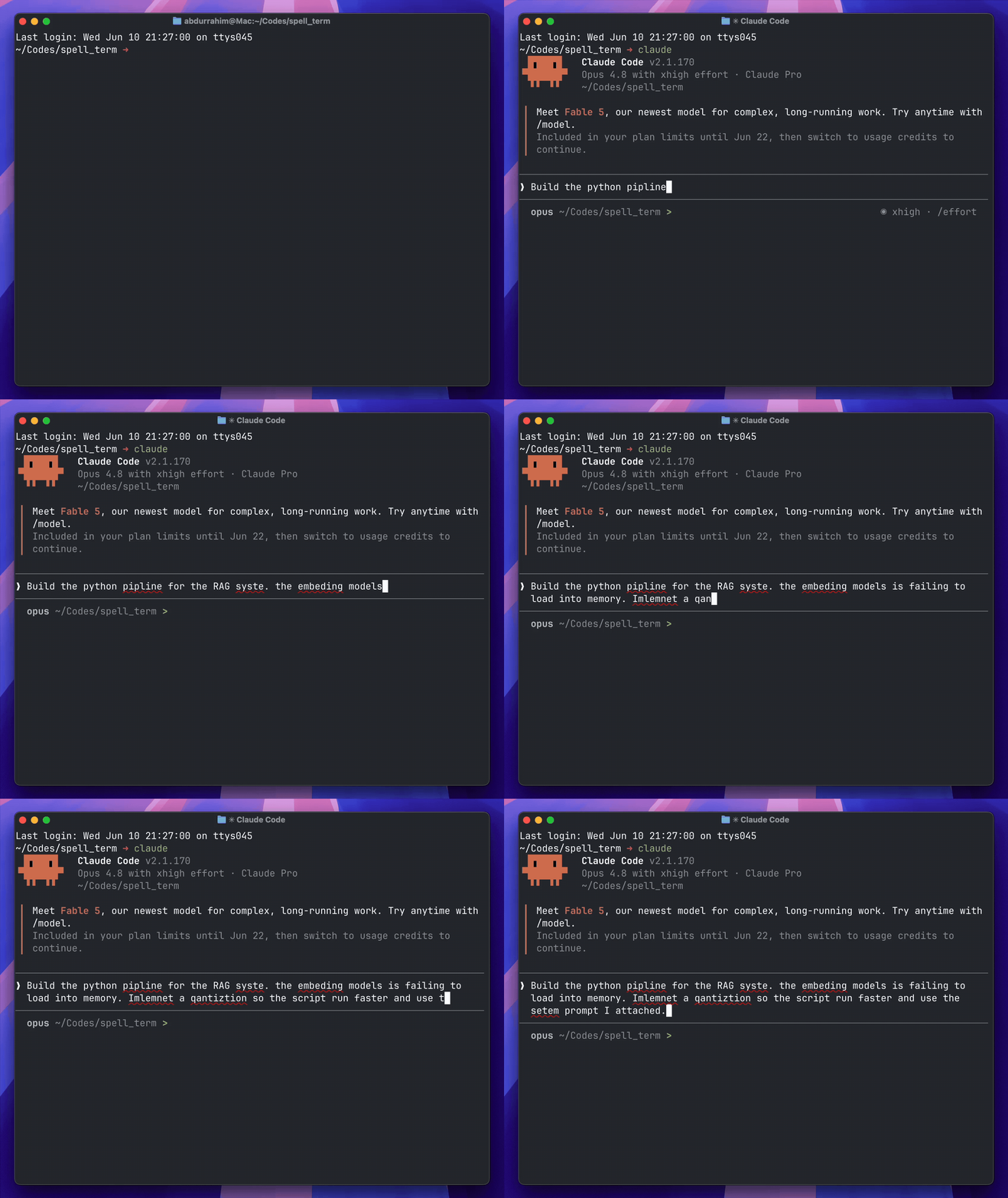
tuipo catching typos in a prompt to Claude Code. It never touches the app it's wrapping — the underlines are drawn on top.
Why I made this
I type a lot of prose into terminal apps — long prompts for **Claude Code**, **Codex** and other AI agents, commit messages, SQL, quick notes. None of them spell-check, so my typos just sail straight through into prompts and history. My editor has had the red squiggly line for years; my terminal never got it.
So I built it. You wrap a terminal program once, and you get that squiggly line back — in Claude Code, Aider, Codex, vim, `psql`, your shell, whatever. It only shows up when you actually misspell something, and it never changes how the app you're running behaves.
To be fair: modern LLMs shrug off everyday typos — mistype "recieve" and Claude knows what you meant. But that robustness comes from the model having seen a word (and its common misspellings) countless times, so it fades exactly where the stakes are highest: rare words, names, and jargon, where the model quietly guesses — and an agent doesn't ask, it acts on its guess. It shrinks with model size, too: what a frontier model shrugs off, the local Qwen or Gemma behind your coding agent has to guess at. Spelling also outlives the prompt: agents echo your words into commit messages, PR text, c
Related Skills

Meow Coding
Meow Coding — a desktop app (Electron + React) that runs multiple CLI coding agents (opencode, Claude Code, ai


BS Coding
BS Coding — a desktop app (Electron + React) that runs multiple CLI coding agents (opencode, Claude Code, aide

Agentapi
An HTTP API for Claude Code, Goose, Aider, and Codex.


Coding Agent Session Search
Unified TUI and CLI to index and search your local coding agent session history across 11+ providers (Codex, C


Husk
A desktop home for your CLI agent. Wraps claude / copilot / codex / aider in a clean Electron window with PTY,

Fangai
Wrap CLI coding agents (Pi, Claude, Aider, Codex, OpenCode, …) as A2A servers — one command. Built with @a2a-j

Related Agents
Claude Squad
Manages multiple AI terminal agents including Claude Code and Aider in parallel


Ensemble Curator
High-volume triage agent for external-AI-agent PRs (Codex, Jules, Hermes, Droid, Aider, etc.). Analyzes, conso

Agent Of Empires
Claude Code, OpenCode, Mistral Vibe, Codex CLI, Gemini CLI Coding Agent Terminal Session manager via tmux and
