
Cgh — AI skill for Claude Code
Local code graph for AI coding agents.
How to install Cgh
This entry records only its repository, not the path inside it, so there is no
exact command to give. Open altikva/cgh and copy the folder into
~/.claude/skills/, or the file into ~/.claude/agents/.
What Cgh does
Local code graph for AI coding agents. Indexes your repo into Kuzu + SQLite FTS, exposes 30+ MCP tools to Claude Code, Cursor, Codex, IBM Bob and Gemini. Federates across sibling repos. Tool calls cost zero model tokens.
Alternatives in AI
- AGENTS.md - Skill Seekers — Concise reference for AI coding agents 11.1k ★
- Codeseek — Rust-powered code intelligence CLI for AI coding agents 764 ★
- Memtrace Public — Structural memory for AI coding agents 466 ★
README
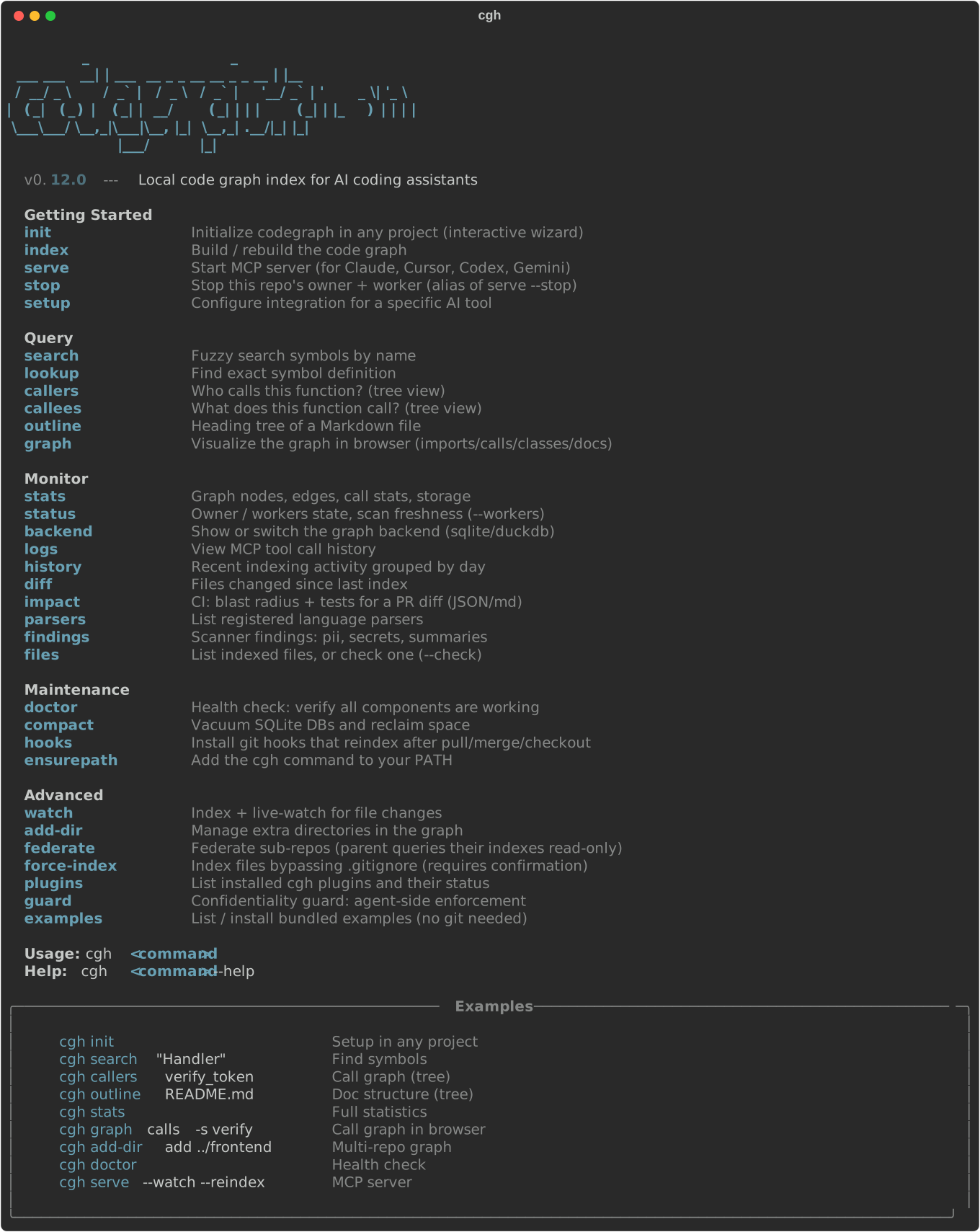
**Local code graph, shared memory and guardrails for AI coding assistants.**
Parses your repo into a graph of files, functions, classes, Terraform resources, and Markdown documentation -- then exposes it as an MCP server so Claude Code, Cursor, Codex, Gemini, and IBM Bob can do symbol-level lookups instead of reading entire files. On top of the graph: a knowledge and session memory every connected agent shares, and a confidentiality layer (findings, egress gate, per-agent guard hooks) that decides what an agent may read and what may reach a cloud model.
**Result:** 40-60% fewer context tokens on typical navigation tasks, learnings that survive context clears, and nothing leaving the machine without a gate.
pip install cgh && cgh init && cgh serveWhy cgh: the measured gains
cgh's job is to keep an agent's working context small and its round-trips few. It answers code questions from the graph, returning exact `file:line`, instead of the agent reading whole files or grepping. That shows up as fewer context tokens and fewer turns, at equal correctness.
The figures below come from a two-arm benchmark: the same tasks run twice against the same repo, once with cgh available and once with Read/Grep only, scored on each session's token usage, turn count, and answer correctness. Cost is compared only across tasks both arms got right, so a cheap wrong answer never reads as a saving.
**On code-navigation tasks: about 40 to 60% fewer context tokens and 20 to 40% fewer turns, correctness unchanged.**
The gap is widest on multi-file questions, where a graph beats text search. For "what breaks if I change `_backend`?", the agent has to follow call edges across a module:
| turns | context tokens | |
|---|---|---|
| Read / Grep | 13 | 2607 |
| cgh | 6 | 886 |
Tha
Related Skills

Singularmem
Singularmem is a local-first persistent memory layer for LLM-driven workflows built in Rust, SQLite, Typescrip

Chat Recall
One memory across every AI coding tool. Indexes Claude Code, Gemini CLI, Codex, OpenCode and Antigravity sessi


Second Brain Cc
Persistent memory + working protocol for AI coding agents (Claude Code). Numbered Markdown vault, stdlib SQLit

Kuzu Memory
Lightweight, embedded graph-based memory system for AI applications. Fast (<3ms recall), offline-first, with M


Init Nexus
You are running the init-nexus session — a setup step that indexes this codebase into a knowledge graph and wi

Reql
REQL – A graph-native code index engine for agents. Scans Python, TypeScript, Go, Rust, Java, and 30+ language

Related Agents
Cross Repo Scout
Searches sibling repos under .claude/project-registries.json sibling_repos[] for prior solutions. Local-first

Bob
Consensus reviewer (codex, static-only sandbox). Also carries the doubt lens every cycle.

Brain Query
Query the Brain teaching graph with natural language. Translates to Cypher, synthesizes insights, never expose
