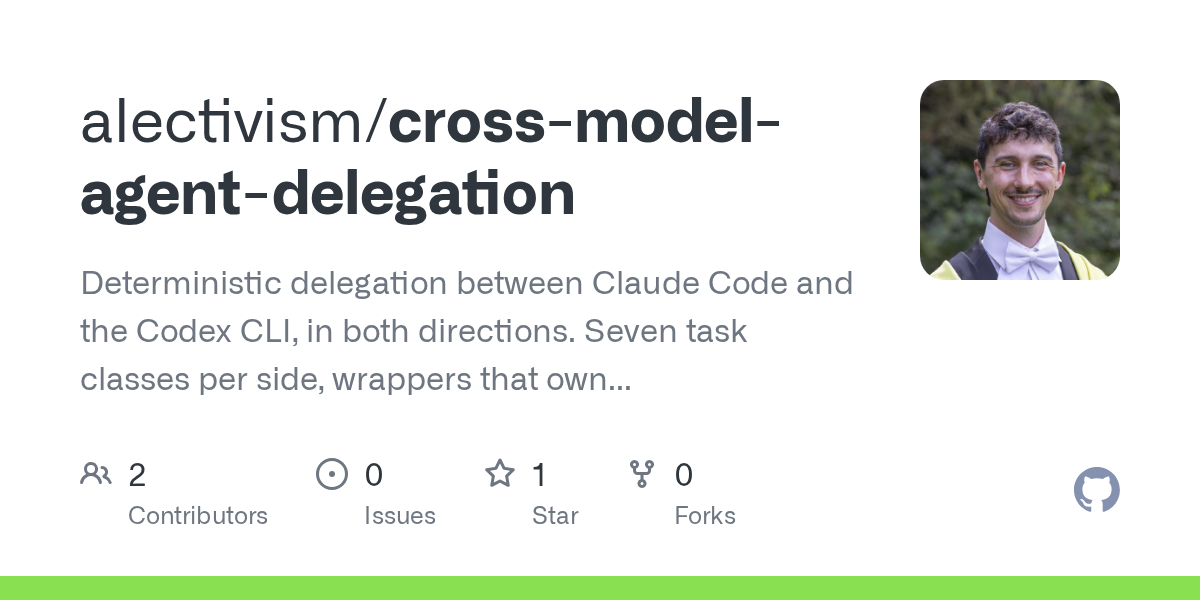

Cross Model Agent Delegation — AI skill for Claude Code
Deterministic delegation between Claude Code and the Codex CLI, in both directions.
How to install Cross Model Agent Delegation
This entry records only its repository, not the path inside it, so there is no
exact command to give. Open alectivism/cross-model-agent-delegation and copy the folder into
~/.claude/skills/, or the file into ~/.claude/agents/.
What Cross Model Agent Delegation does
Deterministic delegation between Claude Code and the Codex CLI, in both directions. Seven task classes per side, wrappers that own every flag, Codex models resolved from the live catalog (GPT-6 ready), model-pinned agent templates, guard hooks, and Teams/Enterprise org guidance.
Alternatives in AI
- Skill Seekers Roadmap — Transform Skill Seekers into the easiest way to create Claude AI skills from any knowledge source - documentat 11.1k ★
- Lumenx Model Onboarding — LumenX 模型接入与文档更新流程 - 厂商文档抓取、model_catalog 更新、运行时范围判断、端到端验证 1.2k ★
- Simulink Agentic Toolkit — The Simulink Agentic Toolkit gives your AI agent both the tools and the expertise to work effectively with Sim 987 ★
README
Cross-Model Agent Delegation
Delegation between [Claude Code](https://code.claude.com) and the [OpenAI Codex CLI](https://developers.openai.com/codex/cli), in **both directions**, with a script owning every flag so the model classifies but never improvises.
This is the setup I run daily as Chief Agent Officer at the Marketing + Media Alliance, extracted and stripped of anything organization-specific. Every claim below was verified against a named CLI version on a stated date, and the failure modes in the "what this cost to get right" sections are ones that actually bit.
- Claude Code → Codex. A Fable/Opus orchestrator keeps planning and synthesis; research, review, retrieval, and bulk edits go to Sonnet/Haiku subagents or to Codex workers on GPT-6 Sol (everyday work), GPT-6 Astra (review and the hardest calls), or GPT-6 Luna (mechanical work) at time of writing, resolved from Codex's live model catalog rather than pinned.
- Codex → Claude Code. A Codex session sends the same shapes of work the other way, to Haiku/Sonnet/Opus workers.
Two reasons to run it either way:
- It cuts expensive-model token burn. Ad-hoc subagents inherit the session model, so an Opus session burns Opus on grep work unless something pins it. Both wrappers pin it.
- It spreads load across two subscriptions. Claude quota and ChatGPT quota are separate pools, so leaf work crossing the boundary makes both last longer. You also get the cross-family bonus: a GPT model reviewing Claude's work, or a Claude model reviewing GPT's, catches errors two same-family models agree on.
You don't invoke any of this by hand. You talk to whichever CLI you're in; the skill and rules make it classify and route on its own:
- "Fix the flaky retry test" → the fix happens locally, then verification goes cross-family as a
review-class call. - "What does our webhook layer actually do?" → an
exploreoringestworker, with only the summary returning to your context. - "Get a second opinion
Related Skills

Claude Glm Switcher
Claude Code --glm mode switcher - Toggle between Anthropic subscription and z.ai API with one flag

AI Battle
Structured judged competition between AI agents where they try to pose each other problems the other side shou

Crossplug
crossplug — AI coding-agent plugin bridge: convert plugins between DSH / MiniMax Code (mcode) / pi, agent-plug

Prompt Tower.Nvim
⚡ Turn your codebase into AI-ready context in seconds – the Neovim plugin that bridges the gap between your co


Openclaw Self Healing
32+ 4-tier autonomous crash recovery for Claude Code and any service — 64% auto-resolved, LLM-agnostic (Claude


Art Direct
Claude Code skill for art directing visuals — ingest content, propose creative directions, generate AI image p

Related Agents

Think Research Framework
Researches a named thinking method, grades its evidence honestly on the seven-tier model, assesses overlap aga

Omd UX Researcher
Reads the resolved oh-my-design reference catalog, researches competing services, validates Tier-1 official de


Retool Parity Audit
Audits the Retool parity checklist against what is actually built, using the export inventories and the Retool
